
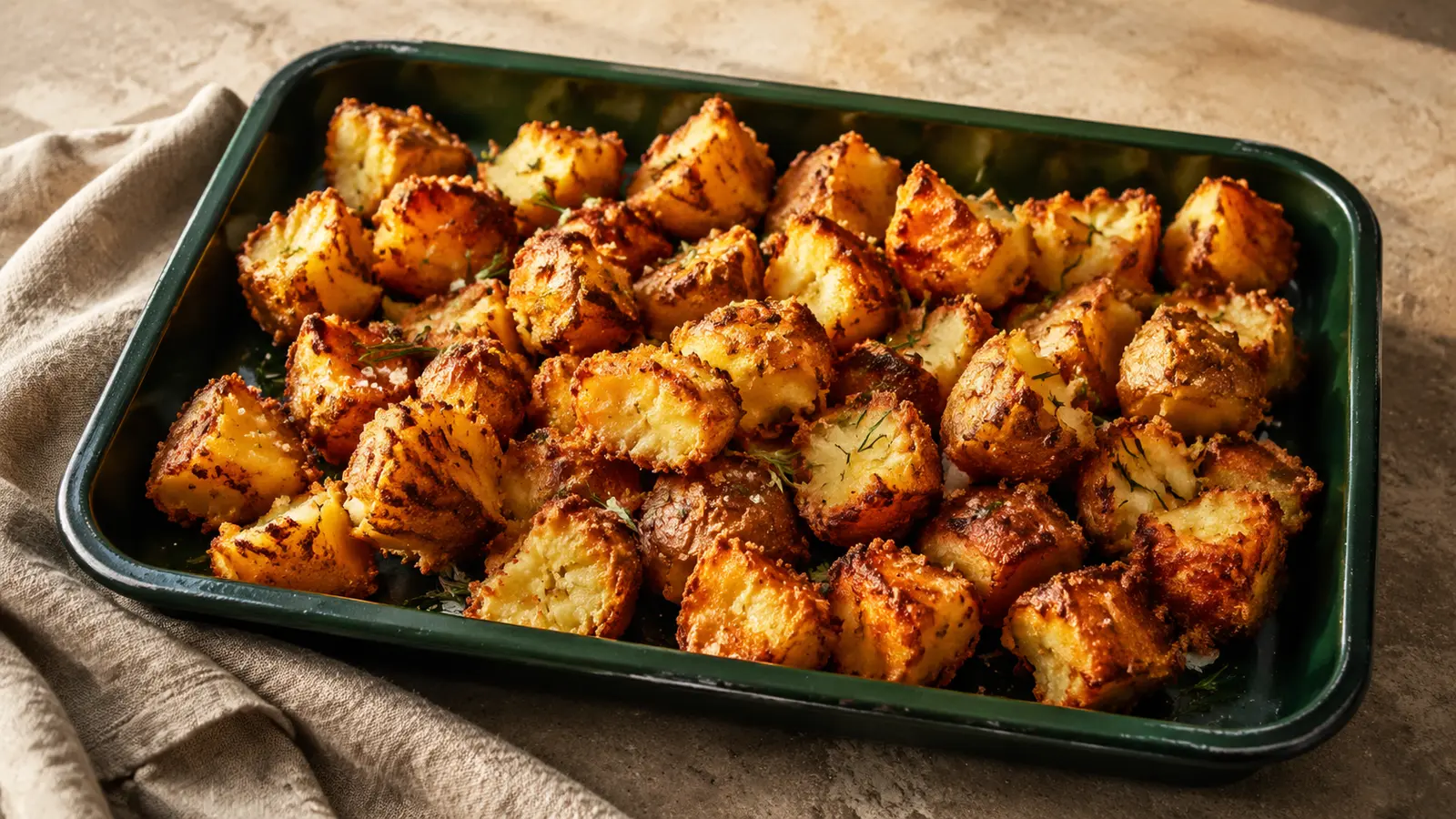
Parboil 1½-inch potato chunks in lightly alkaline salted water, let the steam escape, shake until the edges look mashed and roast with space on a hot metal tray.
Use floury or all-purpose potatoes, ½ teaspoon baking soda in 2½ quarts of water, and enough oil to gloss—not pool. Roast at 450°F, turn only after a firm crust forms, then finish with herbs away from the harshest heat.
The useful contrast in a roast potato is structural: a thick, brittle shell around a light center. Simply raising the oven temperature cannot build that contrast if the surface is still smooth and wet. The method below cooks the center first, creates a rough starchy coating, then gives that coating dry heat and open space.
This is written in weights as well as US measures because potato size, salt crystal size and pan crowding matter more than a dramatic secret ingredient. The timer is a range. The reliable endpoint is a potato that releases from the pan, sounds crisp when nudged and shows deep gold on several faces.
Plan the clock before you begin
- Prep
- 20 min
- Cook
- 1 hr 5 min
- Extra time
- None
- Yield
- 6 side servings
Ingredients, scaled to your table
Showing quantities for 6 servings. Scaling changes ingredient amounts, not pan size or cooking time.
Potatoes
Roasting fat and finish
Use the tool that controls the outcome
- Large pot with room for the potatoes to move
- Colander
- Heavy rimmed metal sheet pan, roughly 13 × 18 inches
- Thin metal spatula or fish turner
- Kitchen scale for the most repeatable ratio
Why each choice earns its place
Potato type
Russets build the roughest shell and fluffiest center. Yukon Golds stay creamier and hold their shape. A half-and-half tray gives both textures.
Baking soda
A small alkaline dose encourages the outer layer to soften during parboiling. That softened starch becomes the craggy coating; too much can make the flavor soapy and the pieces fragile.
Metal pan
A bare rimmed metal pan transfers heat more directly than glass or a deep casserole. Dark pans brown faster, so check the underside early.
Herbs
Infuse the oil gently or add delicate herbs near the end. Raw garlic and rosemary can turn bitter during a full high-heat roast.
Follow the change you can see—not only the timer
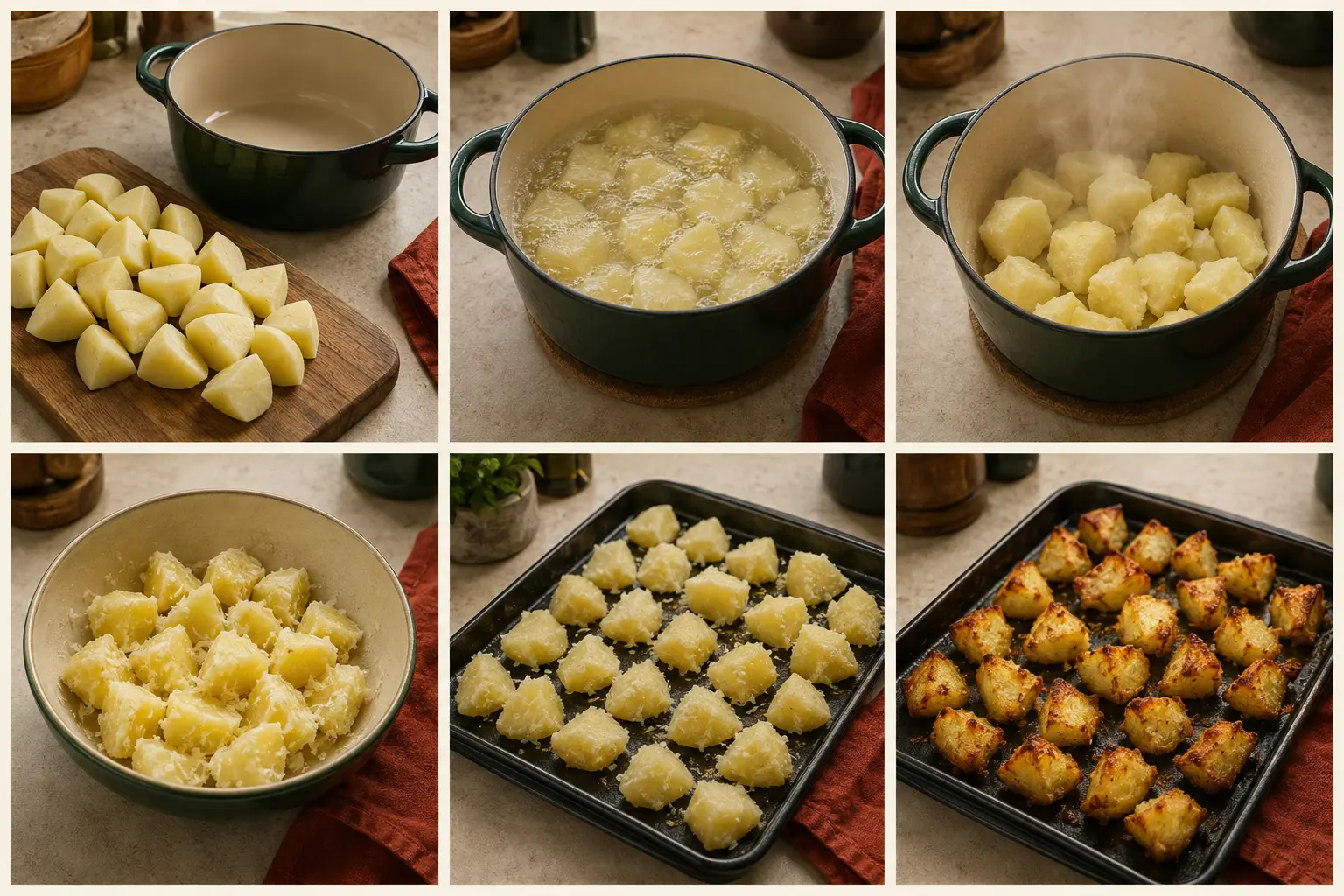
- 1
Heat the oven and pan
15–20 min preheatSet a rack in the lower-middle position and heat the oven to 450°F (230°C). Put the empty metal sheet pan in the oven for the final 10 minutes of preheating.
Look for: The oven is fully heated and the pan is hot, not merely warm.
- 2
Cut for a fluffy center
5 minCut the potatoes into irregular 1½-inch chunks. Keep the pieces close in mass, but leave several broad faces and corners rather than making perfect cubes.
Look for: Most pieces are 45–55 g and have at least two flat sides.
- 3
Parboil until the edges yield
8–10 minBring the water, fine salt and baking soda to a boil. Add the potatoes, return to a gentle boil and cook until a knife meets little resistance at the outside but the pieces do not collapse.
Look for: Edges look slightly fuzzy; the center still supports the chunk.
- 4
Drain and steam-dry
5 minDrain thoroughly, return the potatoes to the warm pot and leave uncovered. Let visible steam escape before adding fat.
Look for: The surfaces turn matte and no water sits at the bottom of the pot.
- 5
Rough the surface
1 minAdd 4 tablespoons oil, pepper and half the rosemary. Cover and shake firmly for 20–30 seconds, or fold with a spoon, until a thick mashed-potato film clings to the chunks.
Look for: Corners are shaggy and coated—not slick, smooth or broken apart.
- 6
Spread with breathing room
2 minCarefully remove the hot pan, add the remaining tablespoon of oil and spread the potatoes in one layer. Put a broad cut face against the metal and leave visible channels between pieces.
Look for: The potatoes sizzle lightly and no piece is stacked on another.
- 7
Roast, release, then turn
40–55 minRoast without disturbing for 20 minutes. Test one piece: if it resists, wait 5 minutes. Turn, then roast 20–30 minutes more, turning once again only if pale faces need contact.
Look for: Several faces are deep gold and the crust releases cleanly from the pan.
- 8
Finish away from harsh heat
2 minToss with the remaining rosemary and flaky salt. For garlic flavor without burnt bits, warm the crushed garlic gently in the oil first, strain it and add the crisp garlic at the end.
Look for: The crust stays audible and the seasoning tastes fresh, not bitter.
The four controls that matter most
Cook the center first
Parboiling lets the oven focus on dehydration and browning instead of slowly softening a raw center.
Create surface area
A roughed starchy coat gives the oil hundreds of thin edges to crisp.
Let steam escape
Dry surfaces crisp; crowded or freshly drained potatoes steam.
Wait for release
A formed crust lifts from metal more cleanly than a half-browned surface.
Diagnose the result before changing the whole recipe
| What happened | Likely cause | Next-batch fix |
|---|---|---|
| Pale after 45 minutes | Wet surface, crowded tray or a cool/light pan | Use two pans, preheat fully and roast until the underside releases before turning. |
| Greasy rather than crisp | Too much oil or too little surface starch | Steam-dry, rough more aggressively and use just enough oil to coat the crags. |
| Burnt herbs | Garlic or rosemary roasted for the full high-heat cycle | Infuse and strain the oil, or add fresh herbs during the final minutes. |
| Pieces fell apart | Overboiling, too much alkalinity or overly vigorous shaking | Reduce the parboil and stop as soon as the edges yield. |
| Crisp outside, dense center | Chunks were too large or under-parboiled | Cut to roughly 1½ inches and confirm a knife enters the outer portion easily. |
Change the flavor without breaking the method
Duck-fat roast potatoes
Replace the oil by volume with melted duck fat. Keep the same spacing and temperature; season after tasting because rendered fats may be salted.
Lemon-pepper potatoes
Roast with black pepper, then add finely grated lemon zest and a squeeze of juice only after the potatoes leave the oven.
Smoky paprika
Add 1 teaspoon smoked paprika to the oil after parboiling. Watch the darkest corners because paprika can taste bitter if scorched.
Air-fryer finish
Parboil and rough as written, then cook a loose layer at the model-approved high setting. Work in batches and use the same color and release cues rather than a universal time.
Protect the texture after the main method
- Up to one day ahead: Parboil, steam-dry and rough the potatoes. Cool promptly, cover and refrigerate. Coat with oil and roast from cold, allowing extra time.
- Reheat: Spread leftovers on a metal pan and heat at 425°F until hot and crisp. Reheat leftovers to 165°F when applicable under USDA guidance.
- Do not cover while hot: Trapped steam softens the crust. Move finished potatoes to a warm uncovered platter if the tray is needed.
Short answers before you start
Why put baking soda in the potato water?
A small alkaline dose softens the potato surface during parboiling, which makes it easier to build a rough starchy coating. More is not better; excess can taste soapy and weaken the pieces.
Which potato makes the crispiest roast potatoes?
Russets usually produce the fluffiest center and roughest shell. Yukon Golds give a creamier center and sturdier shape. A 50/50 mix is useful when a table wants both.
Can I use parchment paper?
You can, but direct contact with a hot metal pan generally browns the underside more efficiently. If sticking is a concern, oil the pan evenly and wait for the crust to release before turning.
Can roast potatoes be made ahead?
Yes. Parboil, steam-dry and rough them a day ahead, then refrigerate promptly. Add oil and roast from cold; expect the roast to take a little longer.
Why are my roast potatoes not crispy?
The most common causes are surface moisture, crowding, a pan that never became hot, too little roughened starch or turning before a crust formed.
How do I keep roast potatoes crispy for serving?
Keep them uncovered in a warm, dry oven for a short hold. Avoid a covered bowl, foil tent or deep pile, all of which trap steam.
What supports the safety and publishing details
- USDA — Leftovers and Food Safety ↗
Cooling, refrigeration and reheating baseline.
- Google Search Central — Recipe structured data ↗
Required and recommended recipe markup fields and image guidance.