
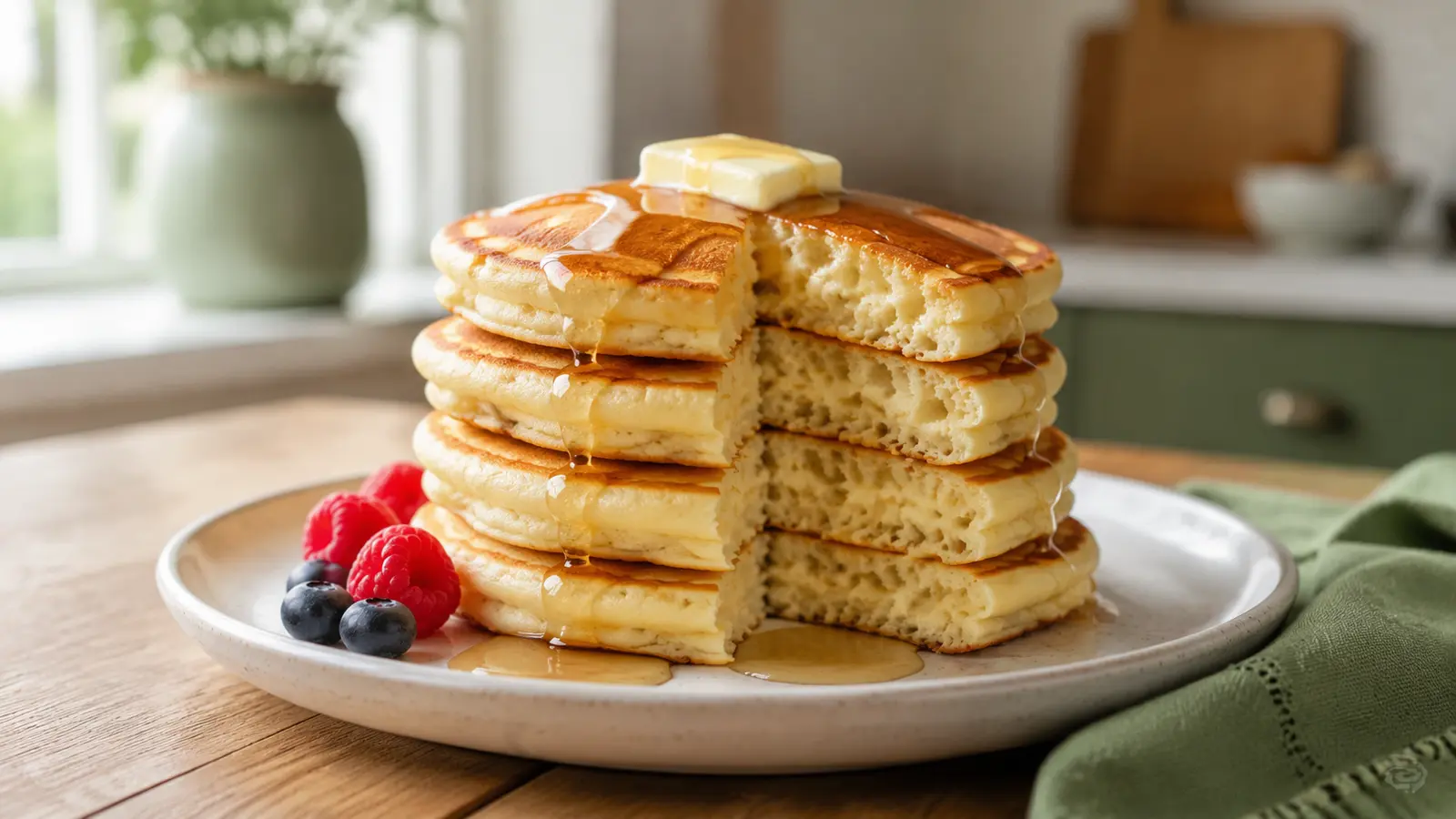
Mix the dry and wet bowls separately, combine only until flour streaks disappear, rest 10 minutes and cook ⅓-cup portions on a 350–375°F griddle until bubbles stay open and the edges lose their wet shine.
Do not chase a perfectly smooth batter. A few lumps protect tenderness. Preheat the griddle before mixing, use a thin film of fat and adjust heat between batches when the first side browns before the center sets.
Pancake height is a race between gas production and batter setting. If the batter is thin, overmixed or poured onto a cool griddle, bubbles escape before the structure can hold them. If the griddle is too hot, the base burns while the middle remains wet.
This formula balances buttermilk acidity with baking soda and adds baking powder for reliable lift. The recipe gives a temperature range because cast iron, nonstick pans and electric griddles transfer heat differently; the first pancake is a calibration tool, not a failure.
Plan the clock before you begin
- Prep
- 15 min
- Cook
- 20 min
- Extra time
- None
- Yield
- 12 four-inch pancakes
Ingredients, scaled to your table
Showing quantities for 4 servings. Scaling changes ingredient amounts, not pan size or cooking time.
Dry ingredients
Wet ingredients
Use the tool that controls the outcome
- Large mixing bowl and medium mixing bowl
- Whisk and flexible spatula
- Electric griddle or heavy skillet
- ⅓-cup measure or 2-ounce scoop
- Instant-read surface thermometer, optional
- Wire rack set over a sheet pan for holding batches
Why each choice earns its place
Buttermilk
Its acidity supports flavor and reacts with baking soda. Thickness varies by brand, so the final batter cue matters more than an extra splash.
Two leaveners
Baking soda balances some acidity and aids browning; baking powder supplies additional lift without requiring more acid.
Cool melted butter
Hot butter can partially cook the eggs or form greasy clumps in cold buttermilk. Let it cool until fluid but barely warm.
Measured scoop
Equal portions cook at the same rate and make griddle temperature changes easier to diagnose.
Follow the change you can see—not only the timer
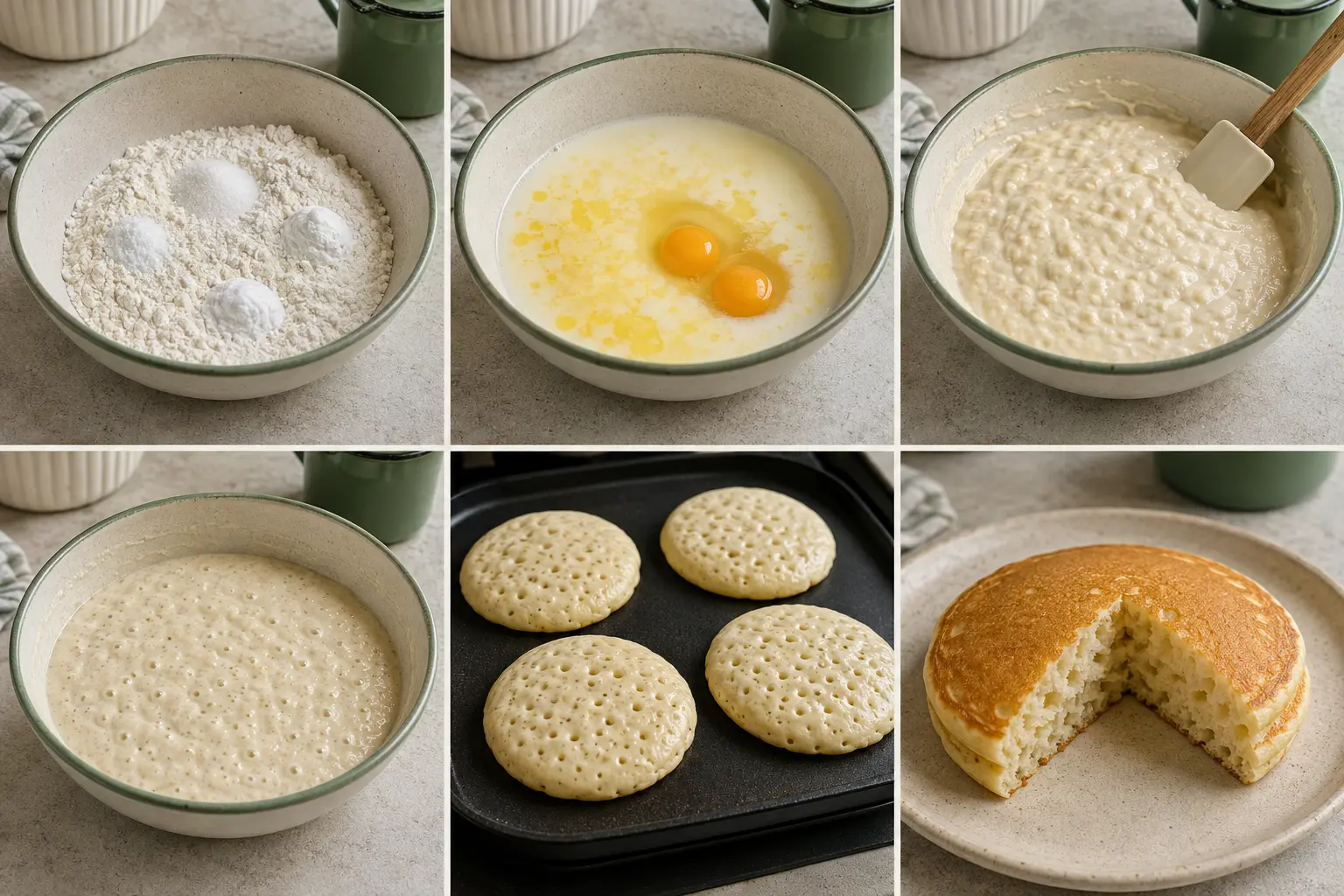
- 1
Preheat before mixing
8–10 minHeat an electric griddle to 350–375°F (177–190°C), or warm a heavy skillet over medium-low. Give cast iron several minutes to heat evenly.
Look for: A test teaspoon of batter sets at the edge within seconds but does not scorch.
- 2
Whisk the dry bowl thoroughly
1 minWhisk flour, sugar, baking powder, baking soda and salt for at least 20 seconds so concentrated pockets of leavener do not remain.
Look for: The mixture looks uniform with no visible soda or powder clumps.
- 3
Whisk the wet bowl
1 minWhisk buttermilk and eggs until smooth, then stream in cooled melted butter and vanilla while whisking.
Look for: The butter is dispersed in fine droplets rather than floating in hard beads.
- 4
Combine just to hydrate
30–45 secMake a well in the dry ingredients, add the wet mixture and fold with a spatula. Stop when no dry flour pockets remain; small lumps are correct.
Look for: The batter falls from the spatula in a thick ribbon and slowly levels.
- 5
Rest briefly
10 minLeave the batter undisturbed for 10 minutes. Do not stir it smooth after resting. If it is too stiff to scoop, fold in 1 tablespoon buttermilk once.
Look for: The surface is slightly aerated and the batter is thick but scoopable.
- 6
Grease lightly and portion
1 min per batchWipe the griddle with a very thin film of oil or clarified butter. Scoop ⅓ cup batter per pancake, leaving enough room to flip without collision.
Look for: The batter spreads to about 4 inches and retains visible height.
- 7
Read the top, then flip once
2–3 min first side; 1–2 min secondCook until bubbles rise and stay open, the edge loses its wet gloss and the underside is golden. Flip once; cook until the second side is golden and the center springs back.
Look for: Open bubbles remain on top and the spatula slides under a set edge.
- 8
Hold without steaming
Up to 20 minMove pancakes to a wire rack in a 200°F oven for no more than 20 minutes. Avoid stacking a large hot pile under foil, which traps steam.
Look for: Surfaces remain dry and the centers stay tender.
The four controls that matter most
Lumps are protective
Mixing until glassy develops gluten and knocks out early gas; a few hydrated lumps disappear during cooking.
Heat must match thickness
A thick pancake needs moderate heat long enough for the center to set before the base burns.
One flip preserves lift
Repeated flipping presses and cools the pancake without improving the center.
First pancake calibrates
Use its color and timing to adjust the pan before committing the rest of the batter.
Diagnose the result before changing the whole recipe
| What happened | Likely cause | Next-batch fix |
|---|---|---|
| Flat pancakes | Old leavener, thin batter, overmixing or a cool griddle | Check expiration dates, weigh flour, stop mixing early and preheat fully. |
| Dark outside, raw stripe | Griddle too hot or portions too large | Lower heat, keep portions at ⅓ cup and wait for persistent bubbles before flipping. |
| Pale and dry | Griddle too cool, long cook or too little fat | Raise heat slightly, use a thin fat film and stop when the center springs back. |
| Tough or rubbery | Overmixed batter or pancakes pressed after flipping | Fold only to hydrate and never press with the spatula. |
| Uneven spotting | Pooled butter or an unevenly heated pan | Wipe on a thin fat film and let the pan recover between batches. |
Change the flavor without breaking the method
Blueberry
Scatter 1 tablespoon dry blueberries over each poured pancake rather than stirring a large quantity into the bowl.
Chocolate chip
Add chips to the wet surface on the griddle so each pancake receives the same amount and the bowl batter stays structurally intact.
Whole-wheat
Replace 75 g of the flour with whole-wheat flour and add 1–2 tablespoons buttermilk only if the rested batter is too stiff.
No buttermilk
Use 360 g plain yogurt plus 60 g milk. Acidity and thickness vary, so follow the thick-ribbon cue and avoid a watery lemon-milk substitute when possible.
Protect the texture after the main method
- Dry mix: Whisk the dry ingredients up to one month ahead and store airtight. Label the quantity and add fresh wet ingredients before cooking.
- Cooked pancakes: Cool in one layer, refrigerate promptly and reheat on a rack in a 325°F oven or in a toaster until hot.
- Freeze: Freeze cooled pancakes in one layer, then bag with parchment between them. Reheat from frozen until hot throughout.
Short answers before you start
What makes pancakes fluffy?
Fresh leaveners, a thick but scoopable batter, minimal mixing, a short rest and a properly heated griddle let gas bubbles form and become trapped before they escape.
What temperature should a pancake griddle be?
Start around 350–375°F. Use the lower end for thick or large pancakes and adjust after the first one. The base should brown in about 2–3 minutes while the top develops bubbles that stay open.
Should pancake batter rest?
A 10-minute rest helps hydrate flour and lets the batter relax. Much longer can weaken the first burst from baking soda, so mix close to cooking time.
Why should pancake batter stay lumpy?
A few small lumps show the batter has not been overmixed. They hydrate and cook through, while extended whisking develops more gluten and can make pancakes tough.
Can I make the batter the night before?
The finished batter loses some leavening power and can overhydrate. Prepare the dry mix ahead instead, then add fresh wet ingredients shortly before cooking.
How do I keep pancakes warm without making them soggy?
Place them in one layer on a wire rack in a 200°F oven for up to about 20 minutes. Avoid a covered stack that traps steam.
What supports the safety and publishing details
- FDA — Handling Flour Safely ↗
Raw flour and batter safety guidance.
- USDA FSIS — Safe Minimum Internal Temperature Chart ↗
Egg dish and leftover temperature context.
- Google Search Central — Recipe structured data ↗
Recipe markup requirements and image fields.